US12462078 - Modeling simulation and multi-field coupling analysis method and system for electromagnetic railgun system
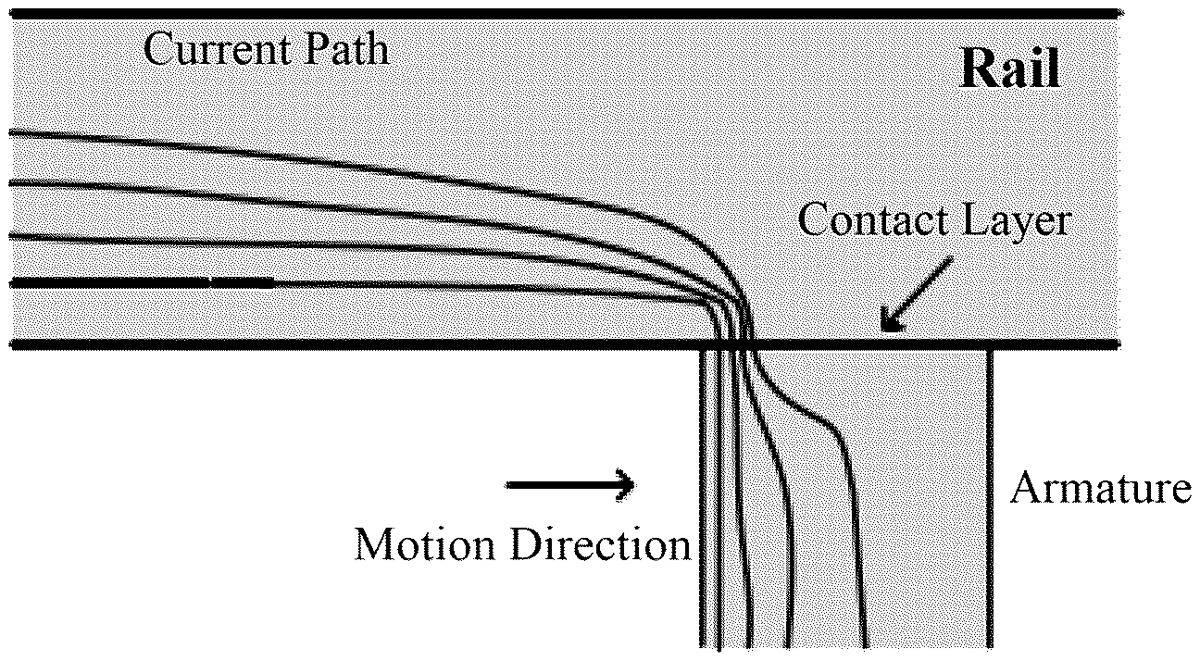
The invention outlines a method for modeling and simulating an electromagnetic railgun system, focusing on building mathematical models for various components and conducting multi-field coupling analysis to ensure reliability and safety during the launching process. It includes detailed processes for modeling pulse shaping, armature impedance, rail resistance, and dynamic armature behavior, ultimately aiming to identify and mitigate issues such as severe ablation and electric contact arcing.
Claim 1
- A method for modeling-simulation and multi-field coupling analysis of an electromagnetic railgun system before launching process to ensure the reliability and safety of the electromagnetic railgun system, comprising the following steps: building, respectively, a mathematical model of pulse shaping unit, a mathematical model of armature impedance, a mathematical model of rail and a dynamic model of armature of an electromagnetic railgun system; forming, by using a modularization method, a simulation model of the electromagnetic railgun based on each of the built models; carrying out a three-dimensional coupling simulation on a current density and a magnetic induction intensity distribution of the simulation model of the electromagnetic railgun, and analyzing a coupling action and distribution characteristics of an electromagnetic field in a launching process of the electromagnetic railgun and an influence of the electromagnetic field on a temperature field distribution; and, determining, based on the analysis result, positions where a severe ablation appeared and/or where an electric contact arcing to be generated on the electromagnetic railgun and taking corresponding actions to prevent and mitigate the occurrence of the severe ablation and/or the electric contact arcing; wherein: a specific process of building the mathematical model of pulse shaping unit of the electromagnetic railgun system comprises: building a model of topological structure according to a topological structure of the pulse shaping unit; dividing a discharge process into a discharge stage and a freewheeling stage according to whether a freewheeling diode is turned on or not when the model of topological structure is provided with a linear load; and, building circuit equations of the two stages respectively to form the mathematical model of pulse shaping unit; a specific process of building the mathematical model of armature impedance of the electromagnetic railgun system comprises: expressing a resistance caused by a skin effect of current on an armature, dividing a contact resistance caused by a skin effect of velocity into two parts, comprising a contact resistance under skin effect of velocity on rails and a contact resistance under skin effect of velocity on the armature, and respectively expressing each part to form the mathematical model of armature impedance; a specific process of building the mathematical model of rail of the electromagnetic railgun system comprises: constructing an expression of resistance of the rails, calculating a resistance gradient of the rails, expressing a skin depth of the rails in combination with the calculated resistance gradient, and constructing a loop current expression of the rails based on a circuit structure of the rails; and a specific process of building the dynamic model of armature of the electromagnetic railgun system comprises: calculating an electromagnetic force on the armature based on magnetic field energy of a launching system, expressing a friction force between the rails and the armature based on a sliding friction coefficient; expressing a dynamic normal pressure on the armature under assumptions that a force acting on the armature is linearly distributed and that a transformation from an axial stress to a radial stress is described by a linear function; expressing an air resistance under assumptions that a density of an air being uncompressed in the rails before electromagnetic launch is of a standard atmospheric state, that a time taken for the air to be compressed is ignored when a shock wave is generated immediately after an armature acceleration, that the density and pressure of the air being compressed are uniform and a specific heat rate is constant, and that the speed of the air being compressed in the rails is consistent with that of the armature; and expressing, in a form of differential equation, a motion equation of the armature based on the friction force between the rails and the armature, the dynamic normal pressure on the armature and the air resistance. building, respectively, a mathematical model of pulse shaping unit, a mathematical model of armature impedance, a mathematical model of rail and a dynamic model of armature of an electromagnetic railgun system; forming, by using a modularization method, a simulation model of the electromagnetic railgun based on each of the built models; carrying out a three-dimensional coupling simulation on a current density and a magnetic induction intensity distribution of the simulation model of the electromagnetic railgun, and analyzing a coupling action and distribution characteristics of an electromagnetic field in a launching process of the electromagnetic railgun and an influence of the electromagnetic field on a temperature field distribution; and, determining, based on the analysis result, positions where a severe ablation appeared and/or where an electric contact arcing to be generated on the electromagnetic railgun and taking corresponding actions to prevent and mitigate the occurrence of the severe ablation and/or the electric contact arcing; wherein: a specific process of building the mathematical model of pulse shaping unit of the electromagnetic railgun system comprises: building a model of topological structure according to a topological structure of the pulse shaping unit; dividing a discharge process into a discharge stage and a freewheeling stage according to whether a freewheeling diode is turned on or not when the model of topological structure is provided with a linear load; and, building circuit equations of the two stages respectively to form the mathematical model of pulse shaping unit; a specific process of building the mathematical model of armature impedance of the electromagnetic railgun system comprises: expressing a resistance caused by a skin effect of current on an armature, dividing a contact resistance caused by a skin effect of velocity into two parts, comprising a contact resistance under skin effect of velocity on rails and a contact resistance under skin effect of velocity on the armature, and respectively expressing each part to form the mathematical model of armature impedance; a specific process of building the mathematical model of rail of the electromagnetic railgun system comprises: constructing an expression of resistance of the rails, calculating a resistance gradient of the rails, expressing a skin depth of the rails in combination with the calculated resistance gradient, and constructing a loop current expression of the rails based on a circuit structure of the rails; and a specific process of building the dynamic model of armature of the electromagnetic railgun system comprises: calculating an electromagnetic force on the armature based on magnetic field energy of a launching system, expressing a friction force between the rails and the armature based on a sliding friction coefficient; expressing a dynamic normal pressure on the armature under assumptions that a force acting on the armature is linearly distributed and that a transformation from an axial stress to a radial stress is described by a linear function; expressing an air resistance under assumptions that a density of an air being uncompressed in the rails before electromagnetic launch is of a standard atmospheric state, that a time taken for the air to be compressed is ignored when a shock wave is generated immediately after an armature acceleration, that the density and pressure of the air being compressed are uniform and a specific heat rate is constant, and that the speed of the air being compressed in the rails is consistent with that of the armature; and expressing, in a form of differential equation, a motion equation of the armature based on the friction force between the rails and the armature, the dynamic normal pressure on the armature and the air resistance.
Google Patents
https://patents.google.com/patent/US12462078
USPTO PDF
https://image-ppubs.uspto.gov/dirsearch-public/print/downloadPdf/12462078