US12480734 - Electrically-powered firearm training device
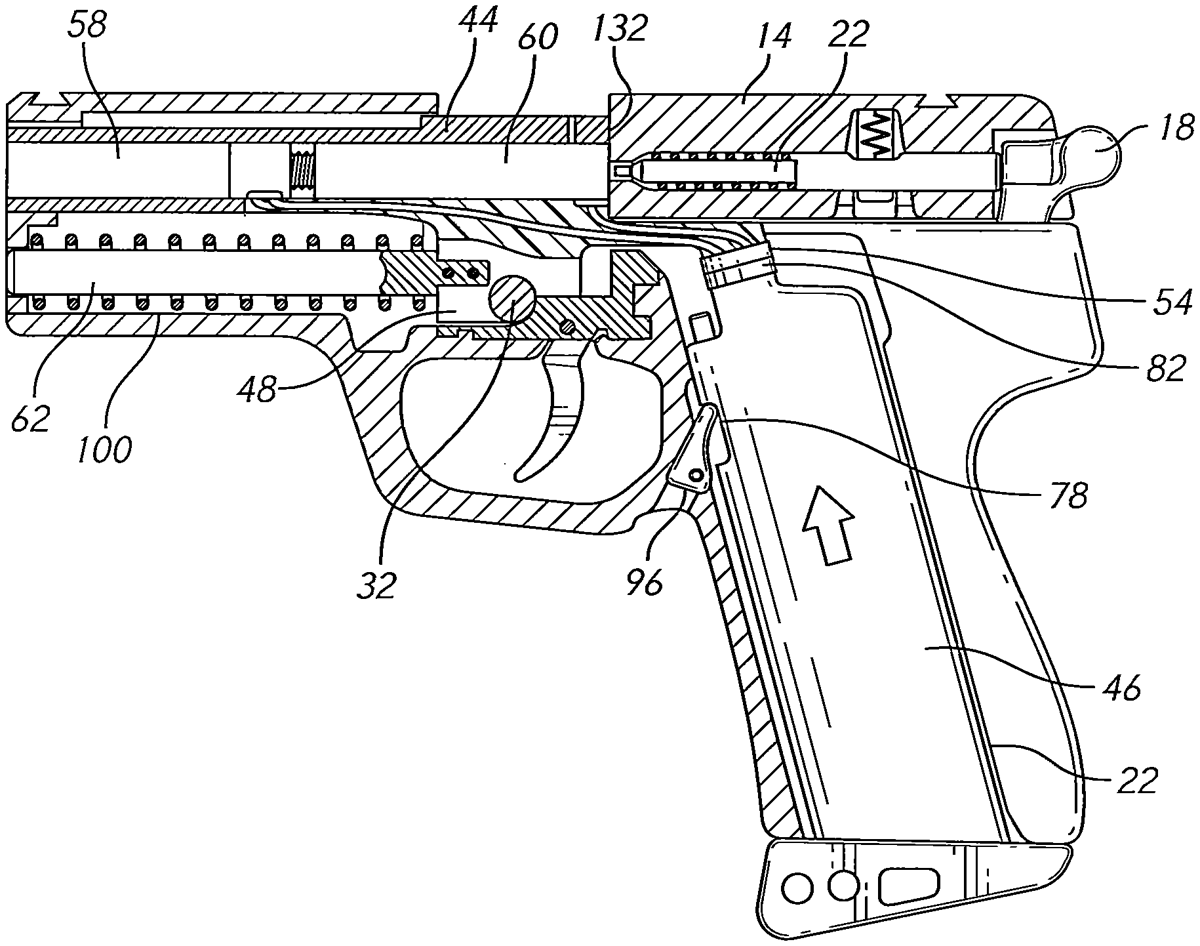
The patent describes an electrically-powered firearm training device that includes a simulator barrel assembly and a simulator magazine assembly, designed to replace conventional components of a firearm. The device utilizes an electric motor and a processor to simulate the operation of the firearm, allowing for realistic training experiences without using live ammunition.
Claim 1
1 . An electrically-powered firearm training device for use in a firearm having a frame, a reciprocating slide attached to said frame, a striker within said slide, a magazine well, and a slide latch, comprising: (a) a simulator barrel assembly installed in said firearm in a position ordinarily occupied by a conventional barrel, including, (i) a barrel, (ii) a motor mounted in a forward portion of said barrel, (iii) a traveler slidably mounted in an aft portion of said barrel, (iv) a jackscrew connecting said motor to said traveler, so that rotary motion of said motor produces linear motion of said traveler, (v) a tang protruding rearward from said barrel to an upper portion of said magazine well, (vi) a first electrical connector mounted on said tang, (vii) a proximity sensor mounted on an aft portion of said traveler, said proximity sensor being configured to detect forward motion of said slider when said firearm is fired, (viii) electrical conductors connecting said motor and said proximity detector to said first electrical connector; (b) a simulator magazine assembly installed in said magazine well in said firearm, including, (i) a second electrical connector configured to mate with said first electrical connector when said simulator magazine is installed in said magazine well, (ii) a processor having an associated memory, said processor running software retrieved from said memory to control the operations of said firearm training device, (iii) a rechargeable battery, (iv) an actuator positioned to activate said slide latch on said firearm; (c) said processor being configured to detect via said proximity sensor the forward motion of said striker and—in response thereto—said processor driving said motor to propel said traveler through an aft and forward cycle to cycle said slide; (d) said processor being configured to count firing cycles since a time when said simulator magazine is first installed in said magazine well; and (e) said processor being configured to—upon the detection of a predetermined number of firing cycles—actuate said actuator in order to activate said slide latch on said firearm. (a) a simulator barrel assembly installed in said firearm in a position ordinarily occupied by a conventional barrel, including, (i) a barrel, (ii) a motor mounted in a forward portion of said barrel, (iii) a traveler slidably mounted in an aft portion of said barrel, (iv) a jackscrew connecting said motor to said traveler, so that rotary motion of said motor produces linear motion of said traveler, (v) a tang protruding rearward from said barrel to an upper portion of said magazine well, (vi) a first electrical connector mounted on said tang, (vii) a proximity sensor mounted on an aft portion of said traveler, said proximity sensor being configured to detect forward motion of said slider when said firearm is fired, (viii) electrical conductors connecting said motor and said proximity detector to said first electrical connector; (i) a barrel, (ii) a motor mounted in a forward portion of said barrel, (iii) a traveler slidably mounted in an aft portion of said barrel, (iv) a jackscrew connecting said motor to said traveler, so that rotary motion of said motor produces linear motion of said traveler, (v) a tang protruding rearward from said barrel to an upper portion of said magazine well, (vi) a first electrical connector mounted on said tang, (vii) a proximity sensor mounted on an aft portion of said traveler, said proximity sensor being configured to detect forward motion of said slider when said firearm is fired, (viii) electrical conductors connecting said motor and said proximity detector to said first electrical connector; (b) a simulator magazine assembly installed in said magazine well in said firearm, including, (i) a second electrical connector configured to mate with said first electrical connector when said simulator magazine is installed in said magazine well, (ii) a processor having an associated memory, said processor running software retrieved from said memory to control the operations of said firearm training device, (iii) a rechargeable battery, (iv) an actuator positioned to activate said slide latch on said firearm; (i) a second electrical connector configured to mate with said first electrical connector when said simulator magazine is installed in said magazine well, (ii) a processor having an associated memory, said processor running software retrieved from said memory to control the operations of said firearm training device, (iii) a rechargeable battery, (iv) an actuator positioned to activate said slide latch on said firearm; (c) said processor being configured to detect via said proximity sensor the forward motion of said striker and—in response thereto—said processor driving said motor to propel said traveler through an aft and forward cycle to cycle said slide; (d) said processor being configured to count firing cycles since a time when said simulator magazine is first installed in said magazine well; and (e) said processor being configured to—upon the detection of a predetermined number of firing cycles—actuate said actuator in order to activate said slide latch on said firearm.
Google Patents
https://patents.google.com/patent/US12480734
USPTO PDF
https://image-ppubs.uspto.gov/dirsearch-public/print/downloadPdf/12480734