US12791292 - Segmented projectile apparatus for firearms
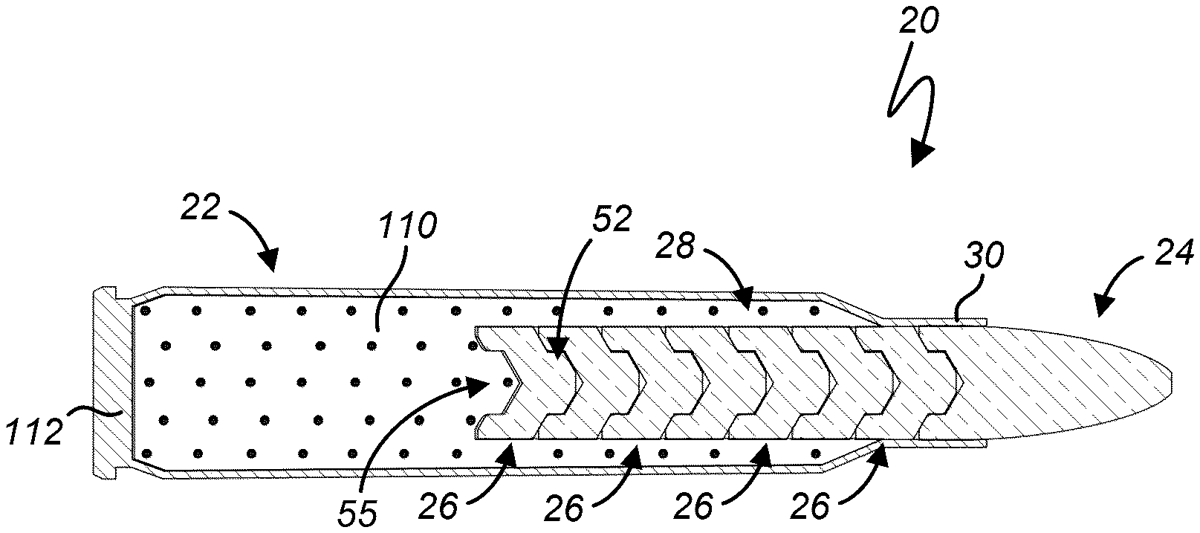
The patent describes a segmented projectile apparatus for firearms that includes a casing and a projectile assembly with a nose and multiple segments that are temporarily engaged. Upon firing, the projectile nose and segments separate in flight, allowing for a radial dispersion towards the target.
Claim 1
1 . A segmented projectile apparatus for a firearm, the apparatus comprising: a projectile casing; a projectile assembly frictionally positioned within the projectile casing, the projectile assembly comprising: a projectile nose and a plurality of projectile segments temporarily engageable with one another in axially aligned series; the projectile nose frictionally positioned within a casing neck of the projectile casing and having a nose leading end and an opposing nose trailing end; each of the projectile segments having a segment leading end and an opposing segment trailing end; the segment leading end of each of the segment projectiles providing an engagement protrusion which provides a protrusion base on which is positioned a protrusion tip; the engagement protrusion of a forwardmost one of the projectile segments configured for being removably engaged with a corresponding rearwardly opening nose engagement cavity provided by the nose trailing end of the projectile nose, so as to create a temporary frictional, press-fit engagement therebetween; and the engagement protrusion of each of an at least one trailing one of the projectile segments configured for being removably engaged with a corresponding rearwardly opening segment engagement cavity provided by the segment trailing end of an immediately preceding one of the projectile segments, so as to create a temporary frictional, press-fit engagement therebetween; and a volume of compressed propellant material positioned substantially between a rearwardmost one of the projectile segments and a casing primer of the projectile casing, such that the propellant material and the casing neck of the projectile casing cooperate to assist with maintaining the temporary engagement between the projectile nose and the projectile segments; whereby, upon the projectile assembly being fired from the firearm via the projectile casing, the projectile nose and projectile segments separate from one another upon subsequently exiting a barrel of the firearm, thereby causing the projectile nose and projectile segments to radially separate from one another in flight toward an intended target. a projectile casing; a projectile assembly frictionally positioned within the projectile casing, the projectile assembly comprising: a projectile nose and a plurality of projectile segments temporarily engageable with one another in axially aligned series; the projectile nose frictionally positioned within a casing neck of the projectile casing and having a nose leading end and an opposing nose trailing end; each of the projectile segments having a segment leading end and an opposing segment trailing end; the segment leading end of each of the segment projectiles providing an engagement protrusion which provides a protrusion base on which is positioned a protrusion tip; the engagement protrusion of a forwardmost one of the projectile segments configured for being removably engaged with a corresponding rearwardly opening nose engagement cavity provided by the nose trailing end of the projectile nose, so as to create a temporary frictional, press-fit engagement therebetween; and the engagement protrusion of each of an at least one trailing one of the projectile segments configured for being removably engaged with a corresponding rearwardly opening segment engagement cavity provided by the segment trailing end of an immediately preceding one of the projectile segments, so as to create a temporary frictional, press-fit engagement therebetween; and a projectile nose and a plurality of projectile segments temporarily engageable with one another in axially aligned series; the projectile nose frictionally positioned within a casing neck of the projectile casing and having a nose leading end and an opposing nose trailing end; each of the projectile segments having a segment leading end and an opposing segment trailing end; the segment leading end of each of the segment projectiles providing an engagement protrusion which provides a protrusion base on which is positioned a protrusion tip; the engagement protrusion of a forwardmost one of the projectile segments configured for being removably engaged with a corresponding rearwardly opening nose engagement cavity provided by the nose trailing end of the projectile nose, so as to create a temporary frictional, press-fit engagement therebetween; and the engagement protrusion of each of an at least one trailing one of the projectile segments configured for being removably engaged with a corresponding rearwardly opening segment engagement cavity provided by the segment trailing end of an immediately preceding one of the projectile segments, so as to create a temporary frictional, press-fit engagement therebetween; and a volume of compressed propellant material positioned substantially between a rearwardmost one of the projectile segments and a casing primer of the projectile casing, such that the propellant material and the casing neck of the projectile casing cooperate to assist with maintaining the temporary engagement between the projectile nose and the projectile segments; whereby, upon the projectile assembly being fired from the firearm via the projectile casing, the projectile nose and projectile segments separate from one another upon subsequently exiting a barrel of the firearm, thereby causing the projectile nose and projectile segments to radially separate from one another in flight toward an intended target.
Google Patents
https://patents.google.com/patent/US12791292
USPTO PDF
https://image-ppubs.uspto.gov/dirsearch-public/print/downloadPdf/12791292