US12800269 - System integration
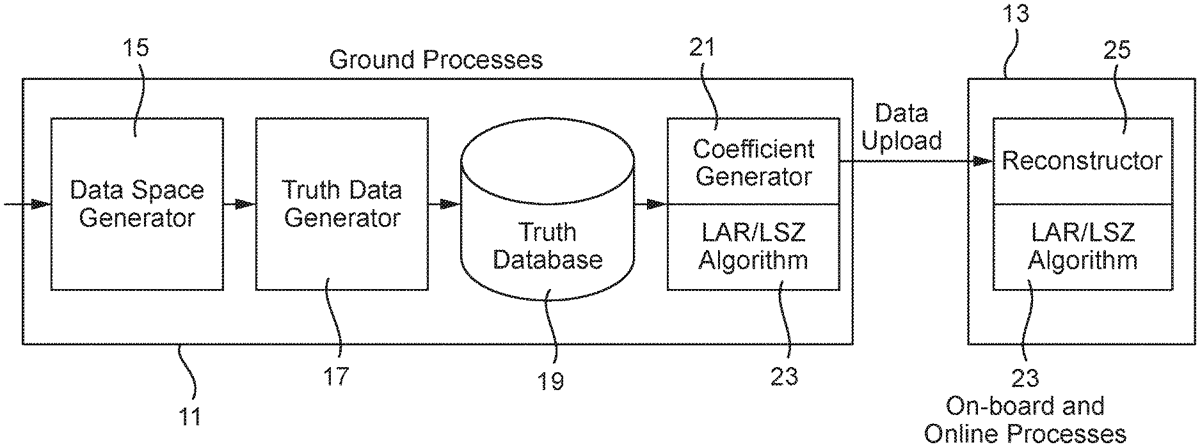
This patent describes a method for generating a feasibility display in an aircraft that indicates the likelihood of a weapon successfully engaging a target or vice versa, utilizing a genetic algorithm to optimize polynomial coefficients based on the weapon’s performance envelope. The process involves creating candidate polynomials from various firing condition parameters, evaluating their fit, and iteratively selecting the best candidate to inform the aircraft’s display.
Claim 1
1 . A computer-implemented method of generating, in an aircraft in flight, a feasibility display indicative of a feasibility of a weapon carried on the aircraft successfully engaging a target and/or a feasibility of a weapon carried on the target successfully engaging the aircraft, the aircraft being capable of carrying one or more types of weapons, the method comprising: providing a database describing a performance envelope of the weapon; creating coefficients characteristic of that performance envelope using a generic algorithm compatible with the one or more types of weapons, wherein the generic algorithm has a form of a polynomial, the creating including: a) generating candidate polynomials, variables of the candidate polynomials being some or all of a group of weapon or aircraft firing condition parameters; b) for each candidate polynomial, computing coefficients for that candidate polynomial which best fit that candidate polynomial to a characteristic of the performance envelope of the weapon using a criterion of least square error; c) for each candidate polynomial, generating a candidate score according to a quality of the fit of that candidate polynomial to the characteristic of the performance envelope of the weapon; d) applying a genetic algorithm to the candidate polynomials and scores including selecting the best scoring candidate polynomial and discarding the other candidate polynomials, thereby identifying a best candidate polynomial and coefficients thereof; and e) repeating said identifying until each of the characteristics of the performance envelope have corresponding polynomial models; uploading, to the aircraft, the coefficients of the identified best candidate polynomial; selecting, by a reconstructor on the aircraft containing the same generic algorithm which is compatible with the one or more types of weapons, coefficients for the generic algorithm according to conditions of the aircraft and the target and a particular type of weapon of the one or more types of weapons; and using the selected coefficients, generating, by the reconstructor, the feasibility display; wherein step d) applying the genetic algorithm to the candidate polynomials and scores comprises: i) defining a set of orders and/or types of the candidate polynomials and dividing the defined set of orders and/or types into a plurality of sub-sets thereof; ii) iteratively applying the genetic algorithm concurrently over the plurality of sub-sets of the defined set of orders and/or types of the candidate polynomials, including iteratively applying the genetic algorithm over the variables of the candidate polynomials for each order and/or type of the respective sub-set thereof and saving the resulting respective coefficients and scores thereof; and iii) selecting the best scoring candidate polynomial using the saved coefficients and scores and discarding the other candidate polynomials, thereby identifying the best candidate polynomial and coefficients thereof. providing a database describing a performance envelope of the weapon; creating coefficients characteristic of that performance envelope using a generic algorithm compatible with the one or more types of weapons, wherein the generic algorithm has a form of a polynomial, the creating including: a) generating candidate polynomials, variables of the candidate polynomials being some or all of a group of weapon or aircraft firing condition parameters; b) for each candidate polynomial, computing coefficients for that candidate polynomial which best fit that candidate polynomial to a characteristic of the performance envelope of the weapon using a criterion of least square error; c) for each candidate polynomial, generating a candidate score according to a quality of the fit of that candidate polynomial to the characteristic of the performance envelope of the weapon; d) applying a genetic algorithm to the candidate polynomials and scores including selecting the best scoring candidate polynomial and discarding the other candidate polynomials, thereby identifying a best candidate polynomial and coefficients thereof; and e) repeating said identifying until each of the characteristics of the performance envelope have corresponding polynomial models; a) generating candidate polynomials, variables of the candidate polynomials being some or all of a group of weapon or aircraft firing condition parameters; b) for each candidate polynomial, computing coefficients for that candidate polynomial which best fit that candidate polynomial to a characteristic of the performance envelope of the weapon using a criterion of least square error; c) for each candidate polynomial, generating a candidate score according to a quality of the fit of that candidate polynomial to the characteristic of the performance envelope of the weapon; d) applying a genetic algorithm to the candidate polynomials and scores including selecting the best scoring candidate polynomial and discarding the other candidate polynomials, thereby identifying a best candidate polynomial and coefficients thereof; and e) repeating said identifying until each of the characteristics of the performance envelope have corresponding polynomial models; uploading, to the aircraft, the coefficients of the identified best candidate polynomial; selecting, by a reconstructor on the aircraft containing the same generic algorithm which is compatible with the one or more types of weapons, coefficients for the generic algorithm according to conditions of the aircraft and the target and a particular type of weapon of the one or more types of weapons; and using the selected coefficients, generating, by the reconstructor, the feasibility display; wherein step d) applying the genetic algorithm to the candidate polynomials and scores comprises: i) defining a set of orders and/or types of the candidate polynomials and dividing the defined set of orders and/or types into a plurality of sub-sets thereof; ii) iteratively applying the genetic algorithm concurrently over the plurality of sub-sets of the defined set of orders and/or types of the candidate polynomials, including iteratively applying the genetic algorithm over the variables of the candidate polynomials for each order and/or type of the respective sub-set thereof and saving the resulting respective coefficients and scores thereof; and iii) selecting the best scoring candidate polynomial using the saved coefficients and scores and discarding the other candidate polynomials, thereby identifying the best candidate polynomial and coefficients thereof.
Google Patents
https://patents.google.com/patent/US12800269
USPTO PDF
https://image-ppubs.uspto.gov/dirsearch-public/print/downloadPdf/12800269