US12808638 - Light-emitting nock for arrows
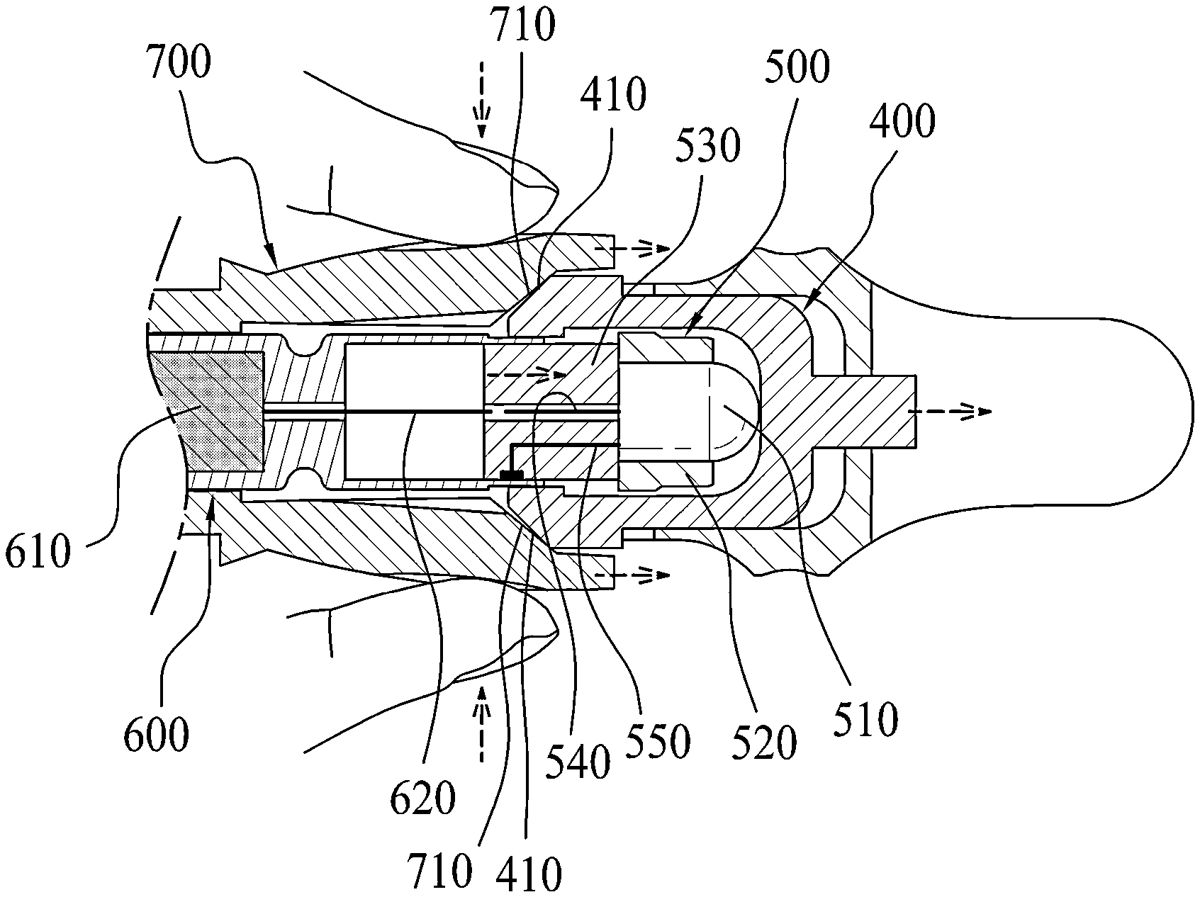
The patent describes a lighted nock for arrows that features a mechanism allowing the luminous lamp to turn off automatically after being activated upon shooting. This design incorporates a turning off switch housing and push buttons that work together to disconnect the power supply to the lamp when the arrow is shot and the buttons are pressed.
Claim 1
1 . A lighted nock for an arrow, comprising: an upper body housing; a lower body housing; a turning off switch housing mounted between the upper body housing and the lower body housing and moving in a forward direction due to a tension of a string when the arrow is shot; a luminous lamp assembly mounted between the upper body housing and the lower body housing, inserted into the turning off switch housing, and moved in a same direction as the turning off switch housing when the turning off switch housing is moved; a battery assembly mounted between the upper body housing and the lower body housing, including an internal battery in contact with the luminous lamp assembly when the luminous lamp assembly is moved, and supplying power so that a luminous lamp mounted on the luminous lamp assembly is turned on; and push buttons configured respectively in the upper body housing and lower body housing, configured to be in contact with the turning off switch housing when the turning off switch housing is moved in the forward direction, and configured to turn off the luminous lamp by moving the luminous lamp assembly in contact with the turning off switch housing in a backward direction and blocking the contact between the luminous lamp assembly and the internal battery of the battery assembly when the push buttons are pressed, wherein stepped portions having an inclined surfaces are formed on the turning off switch housing, an inclined surface is formed on each of the push buttons and are selectively in contact with the inclined surfaces of the stepped portions, wherein angles of the inclined surfaces formed on the turning off switch housing and angles of the inclined surfaces of the push buttons are formed as equal and matching angles, wherein the inclined surfaces of the turn off switch housing are moved in the backward direction relative to the inclined surfaces of the push buttons when the push buttons are depressed by a user. an upper body housing; a lower body housing; a turning off switch housing mounted between the upper body housing and the lower body housing and moving in a forward direction due to a tension of a string when the arrow is shot; a luminous lamp assembly mounted between the upper body housing and the lower body housing, inserted into the turning off switch housing, and moved in a same direction as the turning off switch housing when the turning off switch housing is moved; a battery assembly mounted between the upper body housing and the lower body housing, including an internal battery in contact with the luminous lamp assembly when the luminous lamp assembly is moved, and supplying power so that a luminous lamp mounted on the luminous lamp assembly is turned on; and push buttons configured respectively in the upper body housing and lower body housing, configured to be in contact with the turning off switch housing when the turning off switch housing is moved in the forward direction, and configured to turn off the luminous lamp by moving the luminous lamp assembly in contact with the turning off switch housing in a backward direction and blocking the contact between the luminous lamp assembly and the internal battery of the battery assembly when the push buttons are pressed, wherein stepped portions having an inclined surfaces are formed on the turning off switch housing, an inclined surface is formed on each of the push buttons and are selectively in contact with the inclined surfaces of the stepped portions, wherein angles of the inclined surfaces formed on the turning off switch housing and angles of the inclined surfaces of the push buttons are formed as equal and matching angles, wherein the inclined surfaces of the turn off switch housing are moved in the backward direction relative to the inclined surfaces of the push buttons when the push buttons are depressed by a user.
Google Patents
https://patents.google.com/patent/US12808638
USPTO PDF
https://image-ppubs.uspto.gov/dirsearch-public/print/downloadPdf/12808638