US12716667 - 3D printed bolt receiver with reinforcing blade and picatinny rail
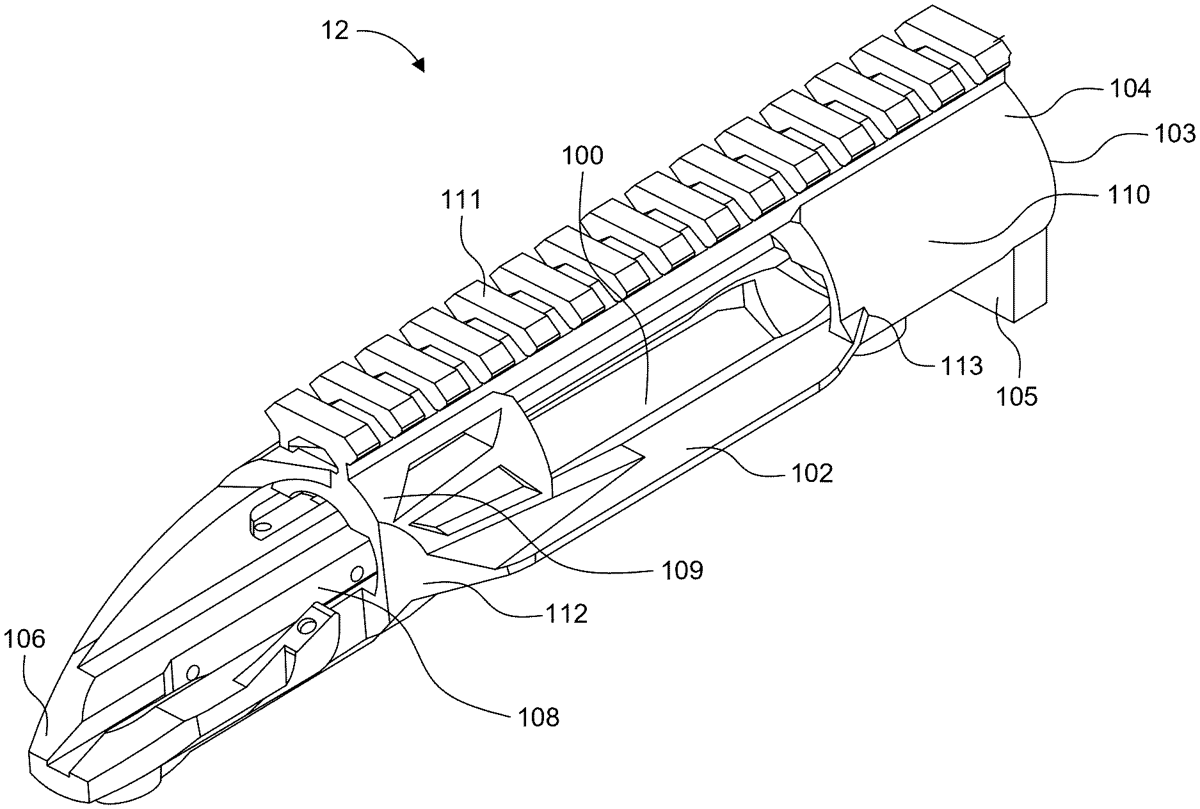
An improved receiver such as for bolt action firearms has an integrally formed reinforcing feature or blade situated below the ejection port. This blade extends longitudinally from the proximal receiver bridge to the distal receiver bridge and may continue into the barrel boss region. Functioning like an arch bridge, the reinforcing blade significantly enhances the structural rigidity of the bolt receiver at its weakest point around the ejection port, reducing flexion during firing and minimizing fatigue. The blade tapers in thickness both laterally away from the receiver's centerline and longitudinally toward the distal end, optimizing material usage while maximizing structural benefits. The bolt receiver is preferably fabricated as a single, monolithic structure using metal 3D printing technology, which allows for the integral formation of additional features such as a Picatinny rail on the top surface and a recoil lug at the distal end portion. These integrated components collectively improve the receiver's functionality, durability, and versatility.