US12510317 - Firearm semiautomatic trigger mechanism
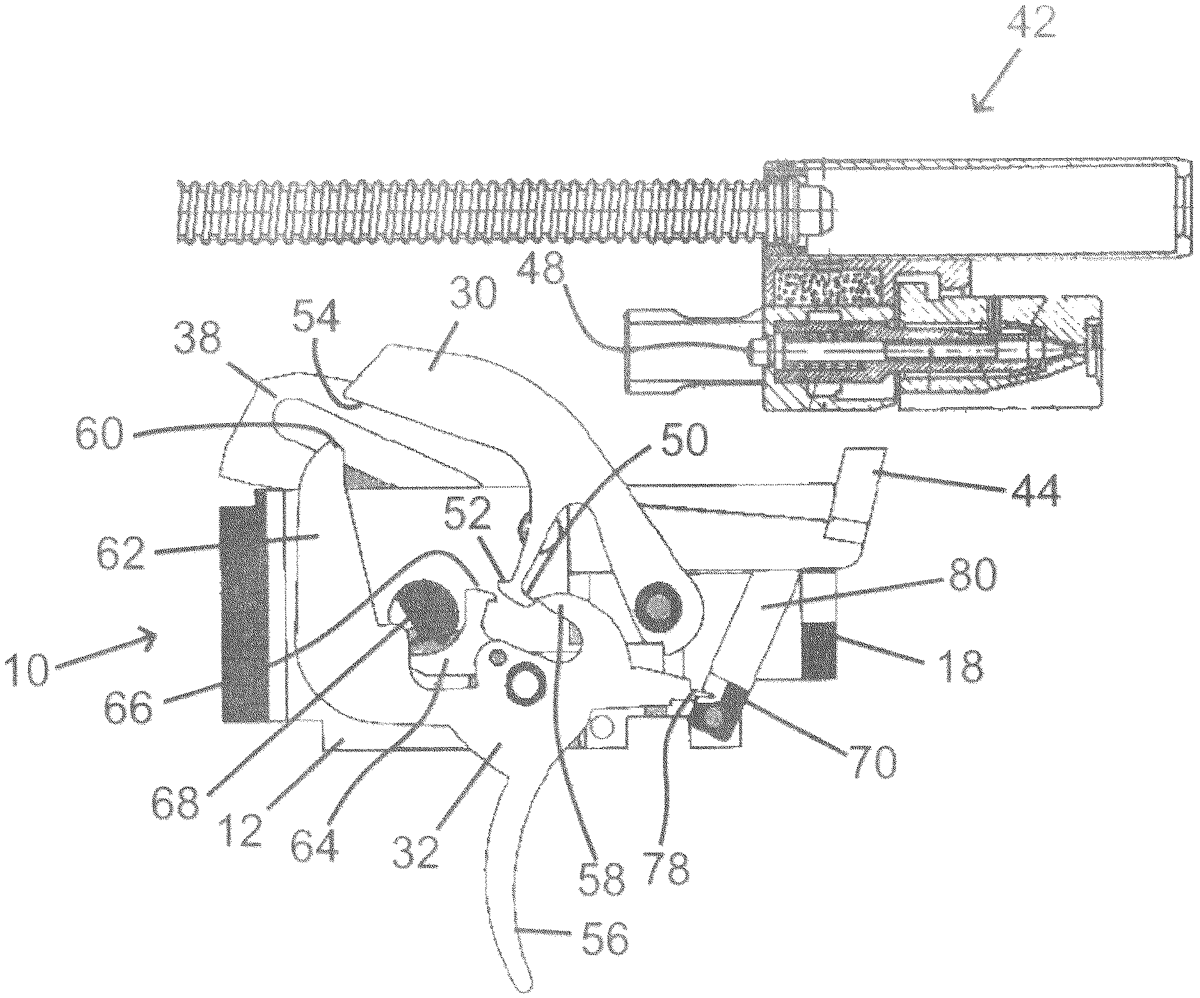
The patent describes a semiautomatic trigger mechanism that incorporates a hammer, trigger member, movable ejector lever, and a locking member to control the trigger’s movement between set and released positions. The locking member, which is spring biased, allows the trigger member to function when the bolt carrier is in a substantially in-battery position, enabling the firearm to fire subsequent rounds.
Claim 1
1 . A firearm trigger mechanism, comprising a hammer having a sear catch, the hammer movable between set and released positions, and the hammer adapted to be moved toward the set position by rearward movement of a bolt carrier; a trigger member having a sear and movable between set and released positions, the trigger member being forced to the set position as a result of cycling action of the bolt carrier, such that the trigger member sear and hammer sear catch are in engagement in the set positions of the hammer and trigger member and are out of engagement in the released positions of the hammer and trigger member; an ejector movable between extended and retracted positions, rearward movement of the bolt carrier contacting the ejector and causing the ejector to be extended into the path of a cartridge casing being extracted from a barrel chamber; a locking member adapted to move between a first position at which the locking member mechanically blocks the trigger member from moving to the released position and a second position at which the locking member does not mechanically block the trigger member allowing the trigger member to be moved to the released position, the locking member being spring biased toward the first position and adapted to be moved against the spring bias to the second position by contact from the ejector during forward movement of the bolt carrier as the bolt carrier reaches a substantially in-battery position; and wherein as the bolt carrier reciprocates to the rear and the ejector is moved to the extended position, the locking member is spring biased toward the first position, and as the bolt carrier returns forward, the ejector is retracted, which in turn moves the locking member to the second position in which it does not block the trigger member from being functioned by an external force away from the set position and when the bolt carrier reaches the substantially in-battery position, the user can pull the trigger member again to fire a subsequent round. a hammer having a sear catch, the hammer movable between set and released positions, and the hammer adapted to be moved toward the set position by rearward movement of a bolt carrier; a trigger member having a sear and movable between set and released positions, the trigger member being forced to the set position as a result of cycling action of the bolt carrier, such that the trigger member sear and hammer sear catch are in engagement in the set positions of the hammer and trigger member and are out of engagement in the released positions of the hammer and trigger member; an ejector movable between extended and retracted positions, rearward movement of the bolt carrier contacting the ejector and causing the ejector to be extended into the path of a cartridge casing being extracted from a barrel chamber; a locking member adapted to move between a first position at which the locking member mechanically blocks the trigger member from moving to the released position and a second position at which the locking member does not mechanically block the trigger member allowing the trigger member to be moved to the released position, the locking member being spring biased toward the first position and adapted to be moved against the spring bias to the second position by contact from the ejector during forward movement of the bolt carrier as the bolt carrier reaches a substantially in-battery position; and wherein as the bolt carrier reciprocates to the rear and the ejector is moved to the extended position, the locking member is spring biased toward the first position, and as the bolt carrier returns forward, the ejector is retracted, which in turn moves the locking member to the second position in which it does not block the trigger member from being functioned by an external force away from the set position and when the bolt carrier reaches the substantially in-battery position, the user can pull the trigger member again to fire a subsequent round.
Google Patents
https://patents.google.com/patent/US12510317
USPTO PDF
https://image-ppubs.uspto.gov/dirsearch-public/print/downloadPdf/12510317